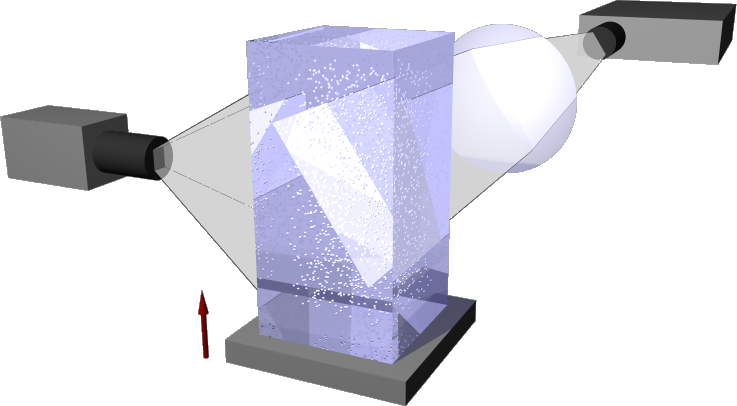
This experiment has been designed to verify the influence of intensity variations of particle images on the RMS error of the PIV analysis. See H. Nobach and E. Bodenschatz: Limitations of accuracy in PIV due to individual variations of particle image intensities. Experiments in Fluids, vol. 47 (2009), pp. 27-38 for details. The glass block moves along one axis of the translation stage, and the plane of illumination is tilted with respect to the axis of motion. While the glass block is translated with a constant velocity of 0.1 mm s-1 through the observation area of the camera, a series of 80 images with 480×480 pixels size is taken at a frame rate of 0.8 Hz. By choosing the number of frames between the two frames to be correlated, different out-of-plane components can be imitated.
Sketch of the experimental setup: a video projector is imaging different illumination profiles into the measurement volume, which is observed by a digital camera. A glass block with internal markers is translated vertically through the measurement volume.
| File | Profile type | Width (mm) | Slope | Out-of-plane component |
|---|---|---|---|---|
| black.zip | background images | |||
| gauss.zip | Gaussian | 3.1 | 0 | 0 |
| gaussr.zip | Gaussian | 3.1 | 0.75 | 1/(33.3 frames) |
| gauss2.zip | Gaussian | 6.3 | 0 | 0 |
| gauss2r.zip | Gaussian | 6.3 | 0.75 | 1/(66.6 frames) |
| gauss2rr.zip | Gaussian | 6.3 | 1.5 | 1/(33.3 frames) |
| tophat.zip | Top-hat | 2 | 0 | 0 |
| tophatr.zip | Top-hat | 2 | 0.75 | 1/(21.2 frames) |
| tophat2.zip | Top-hat | 4 | 0 | 0 |
| tophat2r.zip | Top-hat | 4 | 0.75 | 1/(42.4 frames) |
| tophat2rr.zip | Top-hat | 4 | 1.5 | 1/(21.2 frames) |
 |
AnaPIV - a free analysing program for PIV data |
 nambis
 de]
[2016-08-12]
de]
[2016-08-12]